
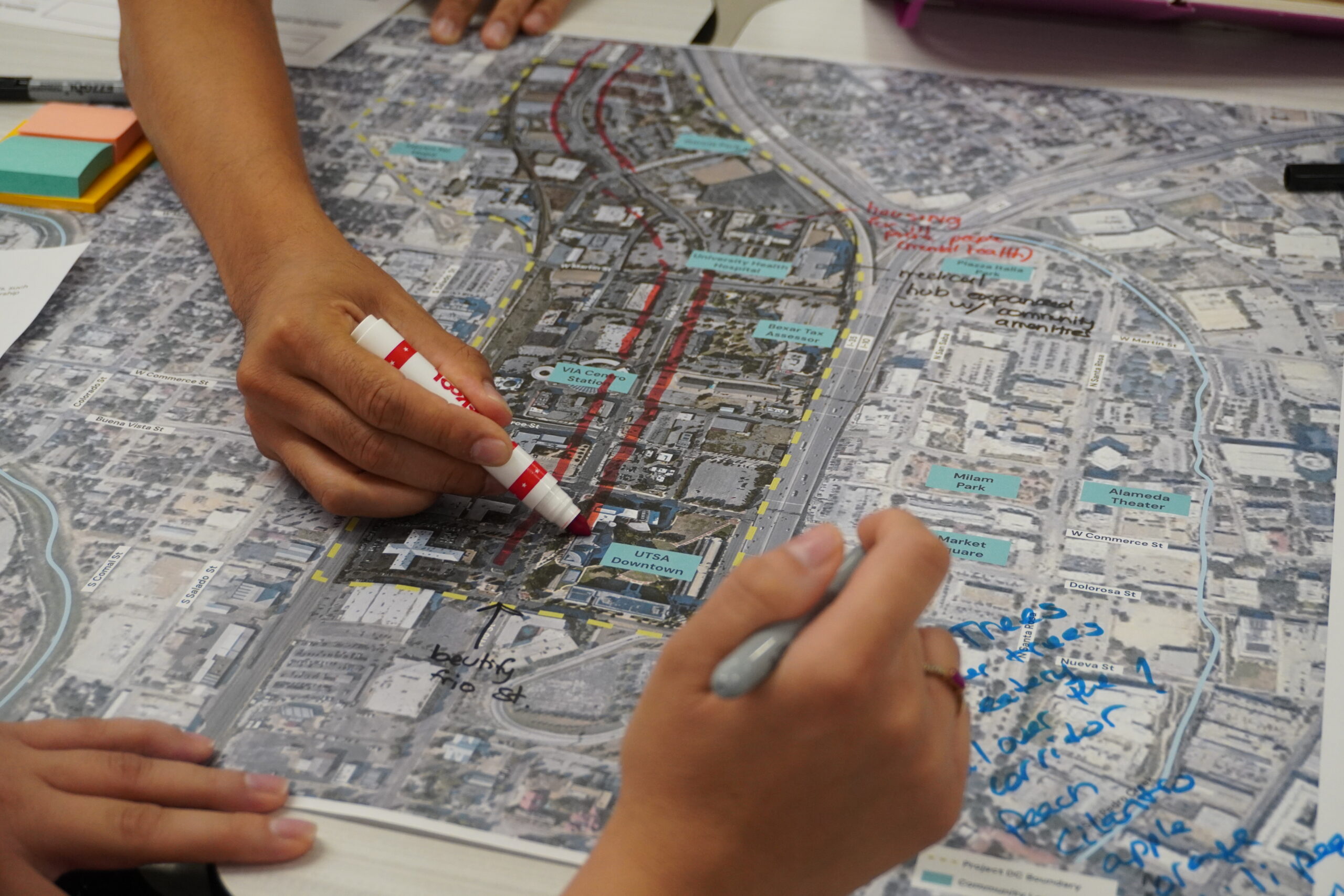

At Urban Alchemy Collective, we approach public engagement as more than a process. It is a practice rooted in intentionality, lived experience, and care.
Too often, engagement is treated as a public awareness campaign… a flyer, a meeting, a presentation. However, our work asks something deeper. It asks us to understand where systems have failed, who has been excluded, and how planning, policy, and design can begin to repair, not just respond.
This work starts with how we listen.
Listening with Intention
Every person we engage with brings a lifetime of experiences, some visible and many not. Trauma, grief, identity, perceived power, experienced systemic oppression and access to resources all shape how people show up in community spaces. These experiences influence trust, voice, and whether someone feels safe enough to participate at all.
There are often invisible lines formed by systems, histories, and power dynamics that create very real boundaries. These lines determine who has access, who feels heard, and who remains on the margins.
Understanding this shifts our role.
We are not just facilitators of meetings. We are stewards of space.
From Cultural Competency to Cultural Humility
One of the most important shifts in our approach is moving away from the idea that we can fully understand a community.
We lead with cultural humility. This means recognizing that we will never know everything about someone else’s experience and that learning is ongoing, fluid and requires maintaince.
Cultural humility is a practice of:
- Self-reflection
- Awareness of bias
- Curiosity instead of assumption
It means asking better questions and allowing people to define their own experiences.
It also means recognizing that even people who share similar backgrounds can have entirely different lived experiences.
Engagement becomes less about expertise and more about connection and respect.
Designing for Trust, Not Extraction
Communities know when engagement is extractive.
Many communities have experienced engagement processes that asked for input without giving anything back. Because of this, trust cannot be assumed. It must be built through care, consistency, and transparency.
Trust is not built through information. It is built through connection, and connection is relational.
Connection starts with understanding who people are, what they have experienced, and what matters most to them. Stories help us get there. They are how people make meaning, process change, and decide whether to engage.
Meeting People Where They Are
Intentional engagement requires flexibility.
There is no one-size-fits-all approach. The way we communicate must shift depending on who we are engaging with, because there is no such thing as a general audience.
Effective engagement asks:
- Who are we trying to reach
- How do they receive information
- What do they care about right now
Sometimes this means changing course:
- From public meetings to pop-ups
- From flyers to text messages
- From presentations to stoop conversations
And sometimes it means letting go of our agenda to best fit the needs of the people we are designing for.
What people need to share may not align with the questions we came to ask, but it is often more important.
Listening Beyond the Agenda
In practice, engagement is rarely linear.
We may arrive with a goal, such as feedback on a design or input on a plan, but communities often bring something else. Concerns about housing, safety, displacement, or basic needs often take priority.
You cannot ask someone to think about a floor plan when they are worried about where they will live.
Engagement requires us to pause and reflect on how we are listening.
Are we listening to understand, or are we listening to respond.
That distinction changes everything.
Power, Access, and Responsibility
Engagement does not happen in isolation. It exists within systems of power.
Some people move through systems with ease, while others encounter barriers at every step. Access to resources, mobility, and opportunity are not evenly distributed.
This matters because in many engagement settings:
- We represent institutions
- We hold perceived authority or perceived power
- We are asking others to be vulnerable
Understanding this imbalance is critical.
Trust is not automatic. It is earned through how we show up.
Our role is not to lead with authority, but to create space for others to lead with their voice.
Toward Repair
At its core, our engagement approach is grounded in a deeper commitment.
We aim to move beyond awareness and toward repair.
Planning and policy have not always served communities equitably. In many cases, they have caused harm. Engagement is not just about participation. It is about rebuilding trust and redistributing power.
This means:
- Designing processes that are inclusive and responsive
- Communicating with clarity and intention
- Creating space for lived experience to shape outcomes
And most importantly, it means showing up with dignity.
Not every interaction comes with a clear plan. But every interaction is an opportunity to listen better, connect more deeply, and design more justly.
About the Author
Paola Fernandez is a community engagement specialist and urban planner with more than 10 years of experience designing and leading intentional, inclusive, and meaningful public engagement processes. Her work focuses on building trust, elevating community voices, and creating engagement strategies that support equitable planning, design, and decision-making.